
Meaning and mechanism
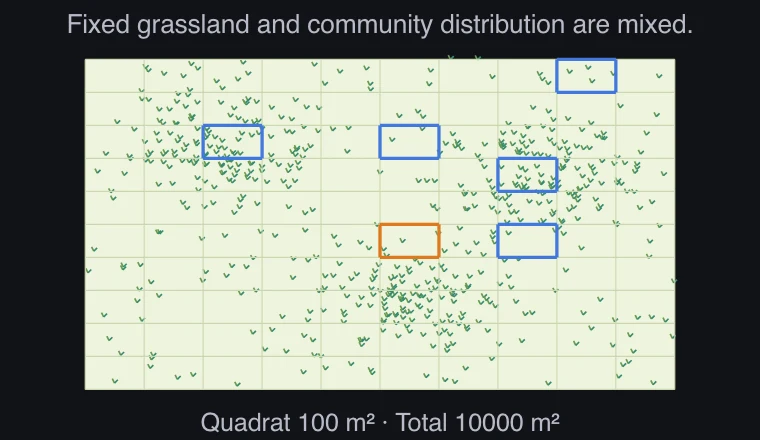
When it is difficult to directly count all of the entities, a specific area is selected for investigation. The number of entities within each area is divided by the area to calculate the density.
When the distribution is concentrated in one area, simply taking samples from nearby locations may not adequately represent the whole. Random positioning or appropriate stratification can help reduce bias.
Relationships and conditions
The total estimated population count is calculated by multiplying the sample average density by the total area. When investigating areas with different regions, it is necessary to consider the investigation area instead of a simple count average.
As the sample size increases, the random error tends to decrease; however, it cannot automatically eliminate bias caused by incorrectly selected positions. It also considers the actual spatial distribution and the mobility of the subjects being surveyed.
What to observe in the simulation
If you repeat random sampling, large samples tend to reduce the average error. Selection bias in selecting clusters does not disappear even if the number of samples is increased.
It is a 100×100 m virtual grassland with 600 fixed objects. We mixed 240 uniformly distributed individuals and 360 individuals from three clusters. To equalize the probability of edge inclusion, the grassland is divided into equal-area grids and then the grids are restored and extracted. Direct placement also fits into this grid, and repeated grids can be counted again. We omit the actual plant size, species classification, seasonal changes, and omission of detection. The average absolute error over 100 trials is a separate random sampling value and does not necessarily decrease from a single result.
Key relationships and symbols
Estimated number of individuals = average density (individuals/m²) × 10000 m²
| Symbol | Meaning | Unit |
|---|---|---|
| Density | Number of individuals per unit area | individuals/m² |
| A_total | Total area surveyed | m² |
Worked example
What is the equation for estimating the total population?
The average density is the total number of individuals in the sample/(number of samples × quadrat). Multiply this by the total area of 10000 m².
Common misconceptions
- The fact that a large sample was obtained does not guarantee representativeness.