
Meaning and mechanism
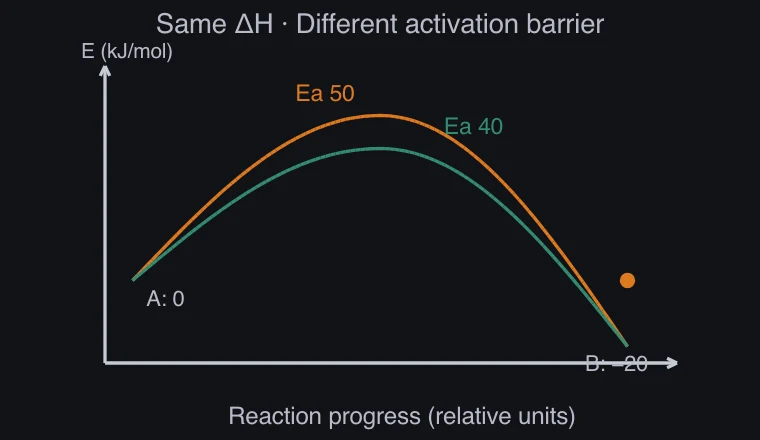
Activation energy is related to the energy barrier along a reaction pathway. A catalyst can provide a pathway with a lower barrier.
The catalyst participates in the reaction steps, but is regenerated within the overall reaction. Therefore, the description that the catalyst does not interact with anything is not accurate.
Relationships and conditions
In the Arrhenius model, when other conditions are constant, as the activation energy decreases, the k value increases. In the energy diagram, the difference between reactants and products, and the height of the barrier, are read separately.
Catalysts alter the time it takes for a reaction to reach equilibrium, enabling both the forward and reverse reactions to proceed rapidly. However, actual catalysts can be affected by contamination, become deactivated, or exhibit varying effectiveness depending on the conditions.
What to observe in the simulation
The fraction of particles above the barrier increases, making the reaction faster. K does not change at the same temperature.
It is a hypothetical energy path and ΔH=−20 kJ/mol. Assume the same frequency factor A=10⁷ s⁻¹. We simplified the Boltzmann energy distribution into a single energy degree of freedom model where p(E)=exp(−E/RT)/(RT). The actual three-dimensional translational energy distribution, catalyst surface, adsorption, and multi-step reactions are omitted. The rate curve only covers the initial forward reaction A consumption and does not calculate the equilibrium composition.
Key relationships and symbols
k catalyst/k non-catalyst = exp[(50−Ea)×1000/RT]
| Symbol | Meaning | Unit |
|---|---|---|
| Ea | Activation energy | J/mol |
| k | Rate constant | Units depend on the reaction order |
Worked example
Which quantities does a catalyst leave unchanged at the same temperature?
Catalysts lower the barriers to forward and reverse reactions. The reactant and product energies and ΔH are the same, so K is the same.
Common misconceptions
- A catalyst does not necessarily increase the equilibrium amount of product by changing the reaction enthalpy or equilibrium constant.