
Meaning and mechanism
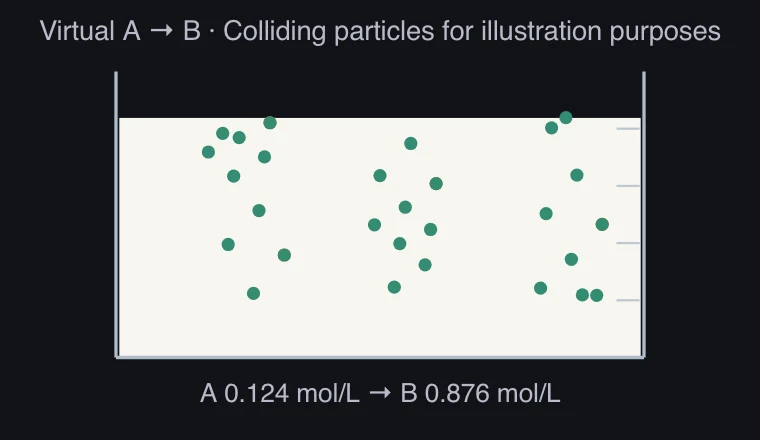
The rate of reaction is the speed at which a product is formed or reactants are consumed. A decrease in the concentration of reactants can alter the opportunities for particles to encounter and react.
In a first-order reaction model, the rate of consumption is proportional to the current concentration. Often, as the temperature increases, the proportion of collisions that can overcome the activation barrier increases, leading to an increase in the rate constant.
Relationships and conditions
A first-order reaction follows [A]=[A]₀e⁻ᵏᵗ. The Arrhenius equation k=Aexp(−Ea/RT) relates the rate constant to activation energy over a suitable temperature range.
The extent of the reaction is not always a value that can be read from the coefficients of a balanced equation. The actual reaction rate law must be determined through experiments and reaction mechanisms.
What to observe in the simulation
Temperature changes the rate constant k, and concentration changes the initial speed v₀=k[A]₀ at the same k.
It is a hypothetical first-order irreversible reaction. Use the frequency factor A=1.00×10⁷ s⁻¹, Ea=50 kJ/mol, R=8.314 J/(mol·K). It is a constant volume and temperature, and reverse reaction, diffusion, and heat generation are omitted. The number of particles and number of collisions are not used in calculations.
Key relationships and symbols
k = A·exp(−Ea/RT) · [A] = [A]₀e⁻ᵏᵗ
| Symbol | Meaning | Unit |
|---|---|---|
| k | First-order rate constant | s⁻¹ |
| Ea | Activation energy | J/mol |
| T | Absolute temperature | K |
Worked example
What changes if you double the initial concentration in a first-order reaction?
v₀=k[A]₀. At the same temperature, k is constant and the half-life is ln2/k, which is independent of concentration.
Common misconceptions
- The fact that the reaction rate increases when the temperature is high, and that the ratio of the final equilibrium products increases, are separate questions.