
Meaning and mechanism
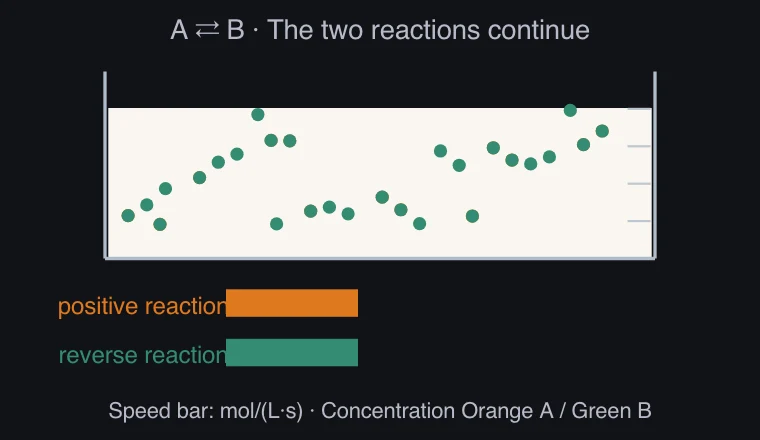
When the rates of forward and reverse reactions are equal within a closed system, the macroscopic concentrations of each substance are maintained at a constant level. This is referred to as dynamic equilibrium.
When adding products or changing reactants, the balance between the two reaction rates is disrupted. As we approach a new equilibrium suitable for the conditions, the concentrations change again.
Relationships and conditions
In the A⇌B first-order reaction model for this experiment, at equilibrium, kf[A] = kr[B], and [B]/[A] = kf/kr. For a general reaction, the equilibrium equation is established by considering coefficients and activities.
The equilibrium constant varies depending on the temperature of a given reaction. Changing the initial concentration will alter the equilibrium composition; however, arbitrarily changing K at the same temperature is not possible.
What to observe in the simulation
When A is added, the forward reaction becomes faster for a moment, increasing B. In the new equilibrium, the two velocities are the same and the concentration ratio returns to K.
Hypothetical A⇄B first-order reaction, constant volume and temperature. Adding A is an instantaneous increase in concentration without a change in volume. RK4 time interval is 1/120 s. 30 s is a state close to equilibrium and a finite time residual remains. K is the concentration ratio [B]/[A] in this model, and activity and multiple reactions are omitted.
Key relationships and symbols
d[A]/dt = −kf[A]+kr[B] · K = kf/kr
| Symbol | Meaning | Unit |
|---|---|---|
| kf, kr | Forward and reverse rate constants | s⁻¹ (simulation model) |
| K | Equilibrium constant | At standard conditions |
Worked example
What is the correct meaning of dynamic equilibrium?
When kf[A]=kr[B], the concentration becomes constant. [B]/[A]=kf/kr=K and the concentration itself does not have to be the same.
Common misconceptions
- In a state of equilibrium, the concentrations of reactants and products do not necessarily have to be equal, but the rates of reaction in both directions must be equal.