
Meaning and mechanism
Parity checks whether the number of bits 1 satisfies a specified even or odd condition. Knowing that parity is incorrect is different from knowing which bit to correct.
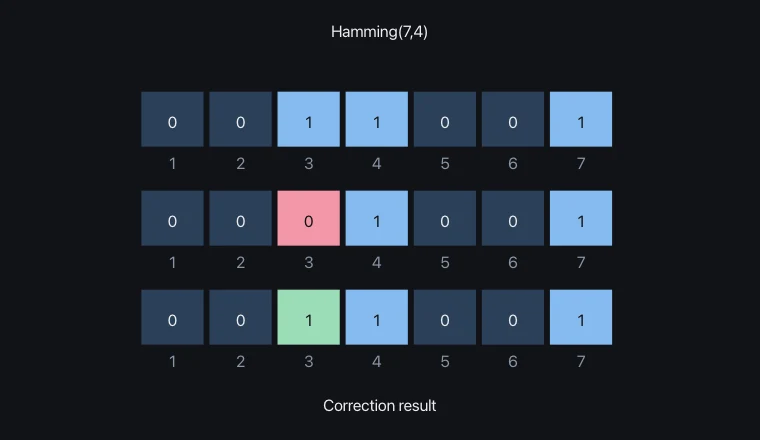
Hamming(7,4) combines four data bits and three check bits into seven bits. A syndrome formed from several check results can identify a single-bit error position.
Relationships and conditions
The syndrome of a received bit sequence r is calculated as Hrᵀ using binary arithmetic. Assuming a single-bit error, flipping the position indicated by the syndrome restores the original sequence.
The basic Hamming code 7,4) does not guarantee the correction of two bit errors. Simple parity checks can also miss an even number of bit flips.
What to observe in the simulation
Hamming parity checks locate a single-bit error.
Hamming(7,4) guarantees only single-bit correction. Two-bit errors may be miscorrected. Parity detects odd error counts.
Key relationships and symbols
Hamming(7,4) · syndrome = H rᵀ
| Symbol | Meaning | Unit |
|---|---|---|
| H | Parity-check matrix | Binary matrix |
| r | Received bit sequence | 7 bit |
| Syndrome | Combination of check results | Binary vector |
Worked example
What if an even number of bits flips under simple parity?
It can miss errors · Hamming parity checks locate a single-bit error.
Common misconceptions
- Flipping the bit indicated by the syndrome does not guarantee recovery from an arbitrary number of errors.