
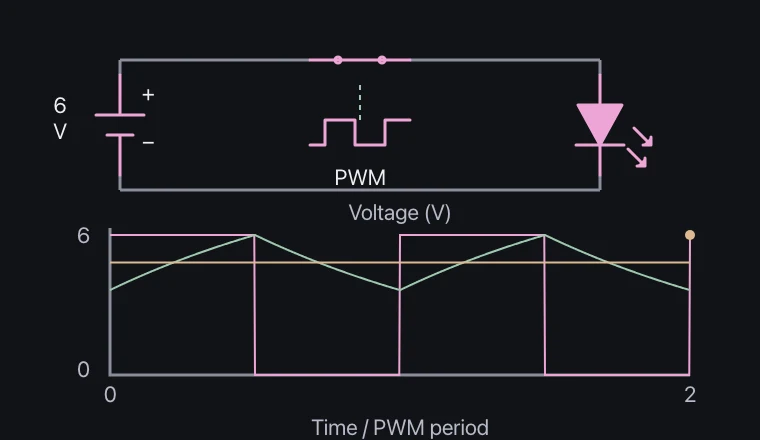
Meaning and mechanism
If the duration, in terms of ‘T’ cycles, for which a light is ‘on’ is Ton, then the duty cycle is D=Ton/T. The method for changing the voltage when the light is turned on, and the method for changing the ratio of the ‘on’ time, are different.
When the voltage is switched on and off quickly, or when dealing with objects with significant thermal or mechanical inertia, the effect tends to approach an average. With slow switching, the fluctuation can be noticeable.
Relationships and conditions
The average voltage of the ideal PWM oscillating between 0 and V is DV. We compare the ripple by changing the 1 response time constant and the switching frequency ratio of the target.
The actual relationship between LED brightness and motor speed is not necessarily linear. It’s important to distinguish this from a relative response model that neglects current paths, load torque, and friction.
What to observe in the simulation
Ideal PWM mean voltage is the duty cycle times the supply voltage.
LED brightness is approximated as proportional to voltage; motor load torque and starting friction are omitted. Experiment on screen; do not reproduce this with real power supplies, outlets or high voltage.
Key relationships and symbols
Vavg = DV · τ y′ + y = u(t)
| Symbol | Meaning | Unit |
|---|---|---|
| D | Duty cycle Ton/T | 0~1 |
| T | Switching period | s |
| τ | Time constant of the system response | s |
Worked example
At 50% duty and 6 V supply, what is the mean voltage when frequency changes from 100 Hz to 500 Hz?
3 V
Common misconceptions
- It is not the case that if the average voltage is the same, the switching waveform or instantaneous current will also be the same.