
Meaning and mechanism
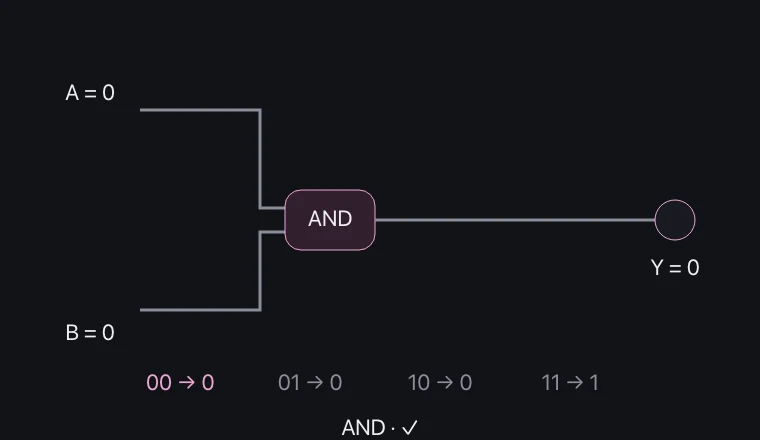
AND outputs 1 when both inputs are 1; OR outputs 1 when at least one input is 1. NOT reverses its input.
If you connect the output of one gate as an input to another gate, you can create more complex logical functions. By combining NAND gates, you can construct NOT, AND, and OR operations.
Relationships and conditions
If the input is n elements, the number of possible binary input combinations is 2ⁿ. By comparing the outputs of each combination, we can verify the logical equivalence of circuits that have different shapes.
The actual 0 and 1 define the permissible voltage range. The logic used in the experiment excludes transmission delay, noise, and intermediate voltage, and the loop connection is treated separately.
What to observe in the simulation
Combining NAND gates can produce NOT, AND and OR.
This is 0/1 combinational logic with no delay or intermediate voltage. Cyclic wiring is an error. Preset wiring modes replace free dragging and also support keyboard operation. Use this simulation; do not reproduce it with real power supplies or wall outlets.
Key relationships and symbols
AND: A·B · OR: A+B · NOT: ¬A · NAND: ¬(A·B)
| Symbol | Meaning | Unit |
|---|---|---|
| A, B | Binary input | 0 or 1 |
| ¬, ·, + | NOT, AND, and OR operations | Logical operator |
Worked example
What is the output when both NAND inputs are connected to A?
NOT A
Common misconceptions
- The logical operator “OR” includes cases where both elements are 1, which is different from the everyday meaning of “exactly one of the two.”