
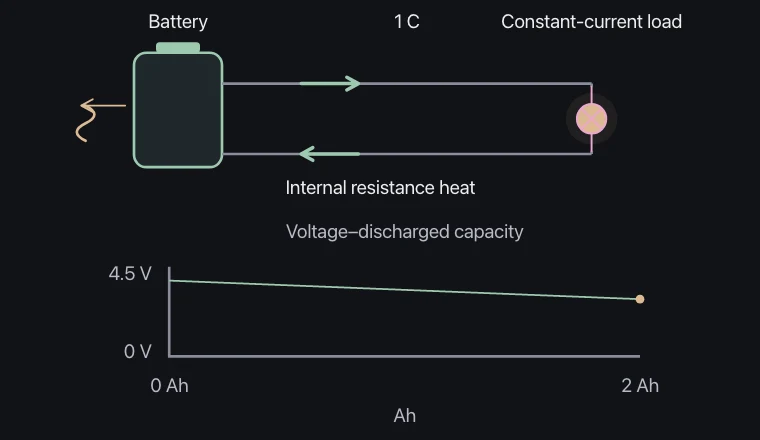
Meaning and mechanism
1 Ah is the charge transferred by a current of 1 A over 1 hour, equal to 3600 C. Calculating energy requires both the voltage and current during discharge.
C-rate is a relative discharge current based on the nominal capacity. High currents can result in an internal voltage drop and a difference in effective capacity.
Relationships and conditions
Energy is represented as ∫VI dt, and when time is input in units of time, it results in Wh. When the voltage changes, an approximation of the exact integral, namely “rated voltage × Ah,” may be used instead.
The observed decrease in the high-rate capacity is a characteristic phenomenon modeled through experience. The actual results vary depending on the type of battery, temperature, aging, and cut-off voltage.
What to observe in the simulation
At high discharge rates, usable capacity falls and internal voltage drop grows. Equal Ah does not guarantee equal energy.
Open-circuit voltage is 3.2+state-of-charge V with 0.06 Ω internal resistance and empirical rate-dependent capacity. It does not predict a specific cell; temperature, aging and protection are omitted. Do not dismantle, short, heat or discharge real batteries under these conditions.
Key relationships and symbols
I = Cnom r · Ceff = Cnom/[1 + 0.08 max(0,r−1)] · E(Wh) = ∫VI dt(h)
| Symbol | Meaning | Unit |
|---|---|---|
| Ah | Charge expressed as current × time | 3600 C |
| Wh | Energy expressed as power × time | 3600 J |
| C-rate | Discharge rate relative to rated capacity | Rate expressed in h⁻¹ |
Worked example
How is energy found when voltage changes over time?
Integrate voltage times current over time · At high discharge rates, usable capacity falls and internal voltage drop grows. Equal Ah does not guarantee equal energy.
Common misconceptions
- It is not possible to directly compare the energy stored by two batteries with different voltages, based solely on their Ah values.