
Meaning and mechanism
One unit of efficiency is calculated by dividing the useful output energy by the input energy. Consider a simple serial chain where the output of the previous step is only transmitted to the next step.
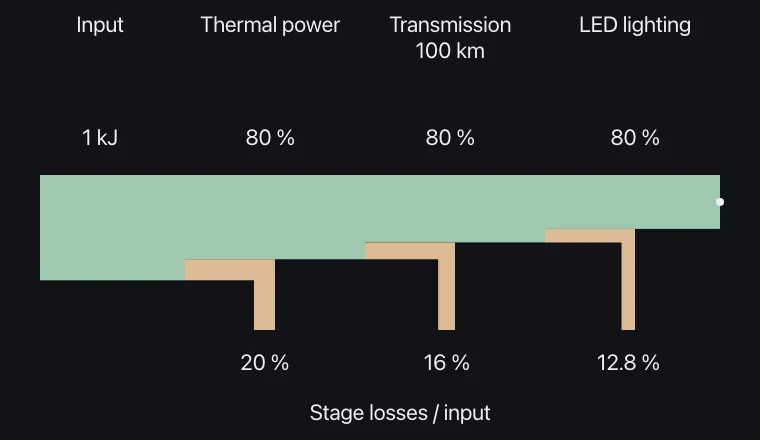
After two stages each with 80% efficiency, 80% of the initial 80% remains. Losing 20% at each stage does not mean simply subtracting 40% of the initial energy.
Relationships and conditions
Eout=Einη₁η₂η₃, and overall efficiency is η₁η₂η₃. The sum of all stage losses and final useful output must equal the initial energy input.
This is a model where each stage has a constant efficiency and there are no return paths or parallel routes. Simply stating that the efficiency is high does not determine the cost or environmental impact.
What to observe in the simulation
Overall efficiency is the product of stage efficiencies. Energy lost at one stage is absent from the next input.
Assumes three independent stages with constant efficiencies. Recovered heat, standby power, time variation and environmental impacts are omitted. Efficiency alone does not establish sustainability.
Key relationships and symbols
Eout = Ein η₁η₂η₃ · ηtotal = η₁η₂η₃
| Symbol | Meaning | Unit |
|---|---|---|
| ηᵢ | Efficiency of stage i | 0~1 |
| Ein, Eout | Total input and useful output energy | J |
Worked example
How do you calculate efficiency across three stages?
Multiply the three efficiencies as fractions · Overall efficiency is the product of stage efficiencies. Energy lost at one stage is absent from the next input.
Common misconceptions
- The arithmetic mean of efficiency at each stage is not the overall efficiency of serial energy conversion.