
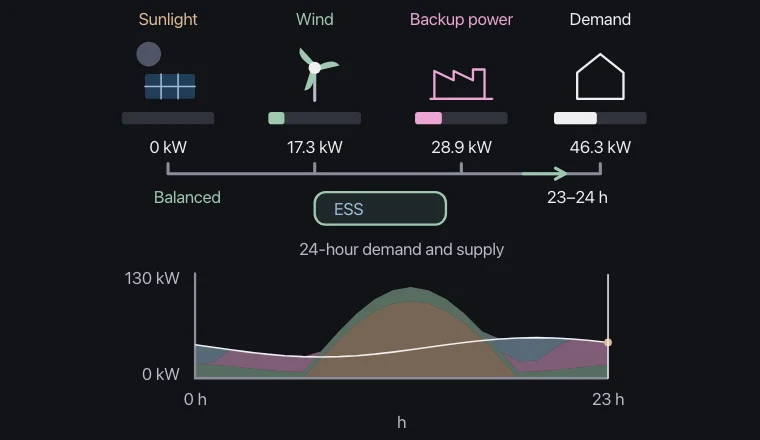
Meaning and mechanism
Power represents the rate of instantaneous energy transfer, while storage capacity represents accumulated energy. It is necessary to add or compare these two quantities using the same units.
When there is more supply than demand, it is possible to store the energy, and when there is less supply than demand, it is possible to discharge it. Even if the battery has the same energy, the function will differ depending on the storage capacity and discharge output limits.
Relationships and conditions
The experiment ensures that the supply, demand, charging, discharging, and output limits are met for each time interval. When charging and discharging efficiencies are applied separately, a cumulative loss occurs.
The system utilizes 24 hours of synthesized data and a simple storage model. Actual grid transmission networks, frequency adjustments, prediction errors, and costs are separate issues.
What to observe in the simulation
Supply and demand must balance every hour. Storage shifts surplus power but has losses and capacity limits.
Uses 24 synthetic one-hour demand, sunlight and wind intervals. Storage starts half full; charge and discharge efficiencies are each 90%. Backup fills shortages. Transmission, forecast errors, frequency control and costs are omitted.
Key relationships and symbols
Demand = Supply + Discharge − Charge − Curtailment · ΔESS = 0.9 Charge − Discharge/0.9
| Symbol | Meaning | Unit |
|---|---|---|
| Output | Rate of energy transfer over a time interval | kW or MW |
| Stored energy | Energy currently stored | kWh or MWh |
Worked example
When total supply exceeds demand, which terms balance it?
Charging and curtailment · Supply and demand must balance every hour. Storage shifts surplus power but has losses and capacity limits.
Common misconceptions
- The mere fact that daily generation output equals daily demand does not necessarily eliminate shortages at every moment.