
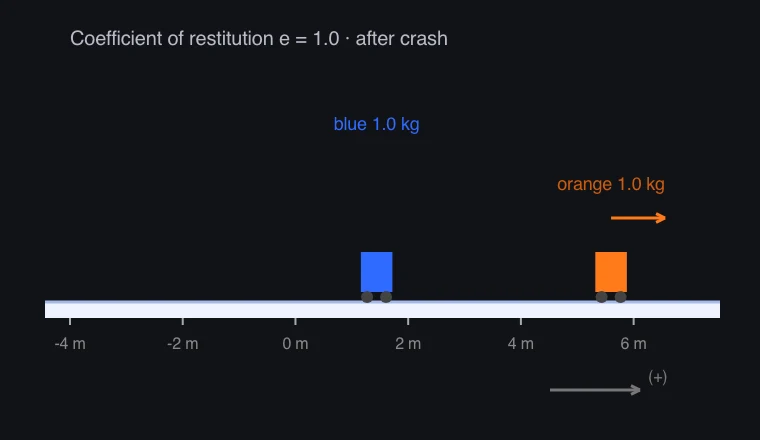
The speed of each individual object may change, but the sum can remain the same.
An object’s momentum is p = mv. If rightward is positive, leftward velocity and momentum are negative. When two carts collide, the forces they exert on each other are equal and opposite, so their mutual impulses cancel in the total momentum balance.
If there is no external impact, it is m₁u₁ + m₂u₂ = m₁v₁ + m₂v₂. ‘u’ represents the velocity before the collision, and ‘v’ represents the velocity after the collision. If friction or significant external driving forces provide a large impact during the collision time, it is impossible to directly use the conservation of motion for both vehicles.
The criteria for distinguishing between elastic collisions and inelastic collisions.
In elastic collisions, the total kinetic energy is conserved. In inelastic collisions, some of the kinetic energy is converted into deformation, heat, and sound, etc. Even in completely inelastic collisions, where two objects move together at the same speed, if there is no external impulse, the total momentum is conserved.
The common speed for complete inelastic collisions is v = (m₁u₁ + m₂u₂)/(m₁ + m₂). It is different from a decrease in kinetic energy, and from the complete disappearance of all forms of energy. When considering energy conversion, it does not contradict the overall principle of energy conservation.
The coefficient of restitution compares relative velocities
For two objects approaching along one dimension, the coefficient of restitution e is the ratio of relative separation speed to relative approach speed. When object 1 catches up with object 2 from the left, v₂ − v₁ = e(u₁ − u₂).
In the experiment, e = 1 represents an elastic collision, and e = 0 represents an inelastic collision. The coefficient of restitution does not indicate how many times a body rebounds at a speed equal to its original speed. To determine the final velocities of the two bodies after a collision, we use mass, initial velocity, and the coefficient of restitution.
Key relationships and symbols
p = mv · m₁u₁ + m₂u₂ = m₁v₁ + m₂v₂ · v₂ − v₁ = e(u₁ − u₂)
| Symbol | Meaning | Unit |
|---|---|---|
| p | Momentum | kg·m/s |
| m₁, m₂ | Mass of each object | kg |
| u, v | Velocities before and after the collision | m/s |
| e | Coefficient of restitution | Dimensionless |
Worked example
What is the final velocity when a 1 kg cart moving at 3 m/s sticks to a stationary 2 kg cart?
The common speed is 1 × 3 + 2 × 0)/3 = 1 m/s. The total amount of motion is 3 kg·m/s in both the forward and backward directions, and the kinetic energy decreases from 4.5 J to 1.5 J. The difference, 3 J, is converted into another form of energy.
Common misconceptions
- Maintaining momentum does not mean that each object has the same amount of movement.
- Even when there is a collision with a rigid body, if the particle is isolated, the total momentum is conserved.