
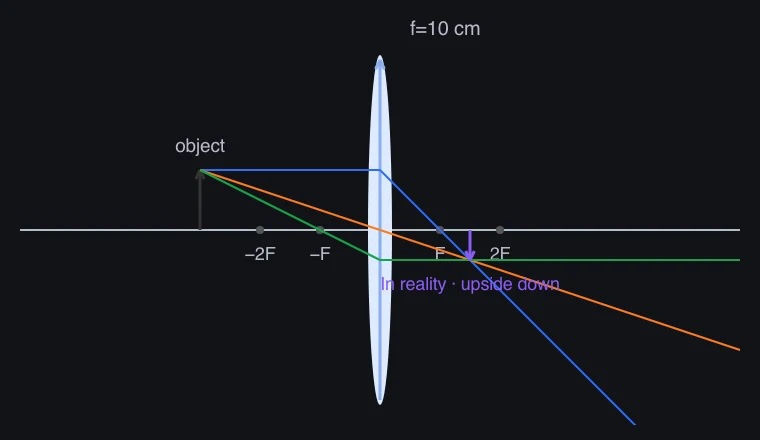
Does actual light encounter it, does the extended line encounter it?
If rays emerging from a lens actually converge, they form a real image that can be projected onto a screen at that position. If the rays diverge but their backward extensions meet, the apparent image is virtual and cannot be projected directly onto a screen at that position.
The method uses three types of light: light that enters parallel to the optical axis and passes through the opposite focus; light that passes nearly straight through the center; and light that enters towards the front focus and then proceeds parallel. The position of the intersection points or the extensions of these light rays are determined.
What happens when an object gets closer to the focal point?
For a real object and a converging lens, take object distance a > 0 and focal length f > 0. Defining image distance as b > 0 for a real image and b < 0 for a virtual image gives 1/a + 1/b = 1/f. If a > f, b is positive and a real image forms on the opposite side of the lens.
If a < f, b is negative and an upright virtual image appears on the object’s side of the lens. At a = f, emerging rays are parallel and no image forms at a finite distance. The image does not shrink away at the focus; this is the boundary where image distance diverges.
Read both the magnitude and sign of magnification
Magnification is m = −b/a: a negative sign means an inverted image, and a positive sign means an upright image. If |m| exceeds 1, the image is enlarged; if it is smaller, the image is reduced. At a = 2f, an inverted real image of equal size forms at 2f. For f < a < 2f, the real image is enlarged.
This formula assumes a thin lens and a small angle of light approaching the optical axis. It neglects the actual thickness of the lens, chromatic aberration, spherical aberration, and diffraction. The translation does not immediately conclude that there is no image if the image or light rays go outside the screen in the diagram; instead, it considers the calculation.
Key relationships and symbols
1/a + 1/b = 1/f · b = af/(a − f) · m = −b/a
| Symbol | Meaning | Unit |
|---|---|---|
| a | Distance from the real object to the lens | cm or m |
| b | Signed image distance | Same units as a |
| f | Focal length | Same units as a |
| m | image height/object height | Dimensionless |
Worked example
With a focal length of 10 cmmm, if an object is 30 cmmm away, what happens?
b = 30 × 10/(30 − 10) = 15 cm and m = −15/30 = −0.5. An inverted real image half the object’s size forms on the opposite side of the lens. Moving the object to 5 cm gives b = −10 cm and m = 2: an enlarged virtual image.
Common misconceptions
- A convex lens does not always magnify. Depending on object distance, it can also produce a reduced real image.
- A virtual image can be seen, but it cannot be projected directly onto a screen at its apparent position.