
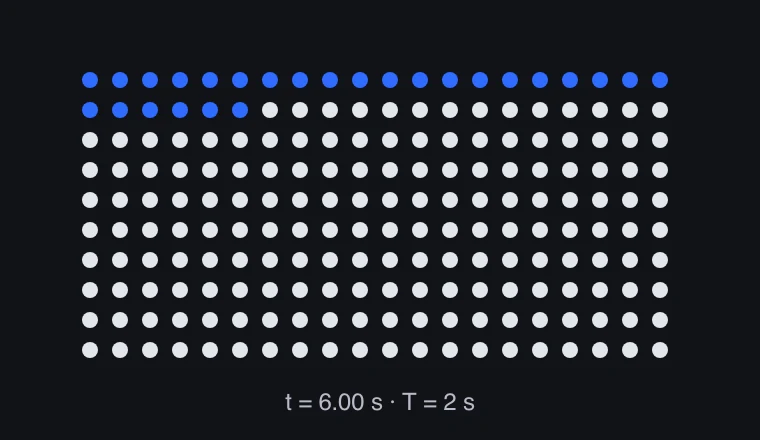
The half-life is calculated based on half of the remaining nuclei.
The half-life, denoted as T½, is the time it takes for the average number of undecayed nuclei of the same kind to decrease to half. If you start with N₀ nuclei, you can predict that after one half-life N₀/2, after two half-lives N₀/4, and after three half-lives N₀/8, the number remaining will not decrease by exactly half of the initial number.
This represents a decay rate of N(t) = N₀2^(−t/T½. The number of nuclei that decay over the same period decreases as the number of remaining nuclei decreases, but the probability of each nucleus decaying within that interval remains constant under the same conditions. It is not the case that already long-lived nuclei will necessarily decay at the next moment.
Why does the curve become erratic when the number of atoms is small?
The index represents an expected value. When independent collapses are executed repeatedly, the individual snapshots change, and the actual remaining number does not precisely halve every time. The relative variation with respect to the expected value is more noticeable when the sample size is small.
Experiments with a fixed random seed can produce the same simulation results when run under the same conditions. Changing the initial seed value alters the timing of individual collapses, but the overall average trend of many nuclei remains consistent. Adjusting the playback speed does not alter the physical half-life.
The number of remaining nuclei differs from activity
The decay constant λ and the half-life have a relationship of λ = ln2/T½. Radioactivity A = λN is the average number of decays per unit time; one unit of Bq represents one decay per second. If the number of nuclei of the same radionuclide is halved, then the radioactivity is also halved.
Even with seed nuclei, if there is a radioactive chain reaction, and if the efficiency of the detector, or the background radiation, exists, then the observed count rate becomes more complex. The experiment focuses solely on a single, independent chain decay, and the marked points and sounds represent a summarized expression of a portion of the entire nucleus.
Key relationships and symbols
N(t) = N₀2^(−t/T½) = N₀e^(−λt) · λ = ln2/T½ · A = λN
| Symbol | Meaning | Unit |
|---|---|---|
| N₀, N(t) | Numbers of undecayed nuclei initially and at time t | items |
| T½ | half life | Time units such as s |
| λ | Decay constant | s⁻¹ |
| A | Activity | Bq |
Worked example
If the half-life is 10 seconds, and the initial number is 800, how many will remain on average after 30 seconds?
Because the half-life has passed, the expected number is 800 × (1/2)³ = 100 items. It is not strictly necessary for the actual random experiment to result in exactly 100 items. It is also not the case that all the nuclei will disappear within 30 seconds.
Common misconceptions
- Half-life is not the time it takes for all nuclei to decay.
- It is not the case that a single nucleus of the same element, which has survived, has a higher probability of decaying in the following half-life.