
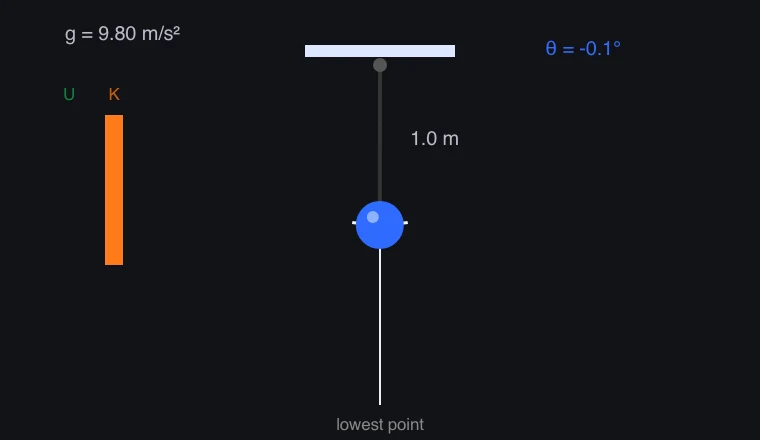
What is the duration of a cycle?
The period, T, is the time it takes for an object to return to its starting position and maintain the same direction of motion. The time it takes to travel from the left end to the right end is one half of a period. If a movement passes through the center in one direction and then another movement passes through the center in the opposite direction, then that movement constitutes one half of a period, and therefore, these movements must be compared with each other.
By measuring the time taken for multiple round trips and then dividing by the number of round trips, it is possible to reduce the error at the measurement point compared to measuring just once. Furthermore, when examining the total time for 3 cycles and the average cycle time together, it becomes easier to read the differences depending on the length.
If the line is long, it becomes slower, and even if gravity is small, it becomes slower.
At a small amplitude, it is T = 2π√(L/g). If the length is increased to four times its original value, the period will become twice as long; if ‘g’ decreases, the period will lengthen. The mass of the pendulum does not appear in this equation. If a heavier weight is attached to the same length, the period will not lengthen.
This result is obtained by approximating sinθ with θ. When angles are represented in radians, these two values are similar for small θ. However, if the angle is significantly oscillated, this approximation becomes inaccurate, resulting in a period that is longer than the prediction of the formula, and also demonstrating the influence of amplitude.
How does the energy change when a lazy Susan rotates?
If there were no friction and air resistance, the mechanical energy of a pendulum would remain constant. At the extreme ends, the tangential speed is 0, and the potential energy due to gravity is large, while at the lowest point, the tangential speed is maximum. Since the tension in the string is perpendicular to the direction of instantaneous motion, it does not perform work in an ideal, fixed-length pendulum.
The actual pendulum’s amplitude gradually decreases due to resistance. When considering factors such as the mass of the string, friction of the axis, and the size of the weight, differences arise compared to the idealized single pendulum model. Before applying the period formula, it is necessary to verify the conditions of a small amplitude and a fixed string length.
Key relationships and symbols
T₀ = 2π√(L/g) (small amplitude) · θ″ = −(g/L)sinθ
| Symbol | Meaning | Unit |
|---|---|---|
| T₀ | Incremental approximation period | s |
| L | Length from the pivot to the bob’s center | m |
| g | acceleration of gravity | m/s² |
| θ | Angle relative to the downward vertical | rad |
Worked example
If you gently oscillate a pendulum with a length of 1 m on Earth, what would be the period?
If g = 9.8 m/s² then T₀ = 2π√(1/9.8) ≈ 2.01 s. If the length is reduced to 0.25 m, the period becomes approximately 1.00 s. Even when only the mass is changed with the same length, this prediction remains the same.
Common misconceptions
- The cycle is not complete just because the zigzag has arrived in the middle.
- The period is an approximation for small amplitudes, but it is not an accurate property for large angles.