
Think about the timing of pushing a swing
By applying pressure periodically in alignment with the direction the swing moves, it is possible to add energy each time. However, if the timing is not correct, even when applying the same force, the vibration does not increase well. This is the reason for distinguishing between the inherent frequency of the vibrating mechanism and the driving frequency applied externally.
Plotting steady-state amplitude against driving frequency gives a response curve. The region near a high peak is the resonance region. The exact maximum can depend on whether the response measured is displacement amplitude, velocity amplitude, or absorbed power.
Why do peaks become lower and wider when damping is high?
Damping transfers oscillation energy into other forms through effects such as friction or resistance. A finite steady-state amplitude results when driving energy balances losses. Weak damping often gives a sharper response concentrated near particular frequencies.
If a linear system is ideally driven to achieve zero loss and maintains a precise resonance condition, the amplitude can increase over time. However, in reality, it does not increase infinitely due to factors such as friction, non-linearity of the material, and limitations of the driving device. This phenomenon is not necessarily one that always leads to destruction.
In the resonance experiments, what types of resonance are demonstrated?
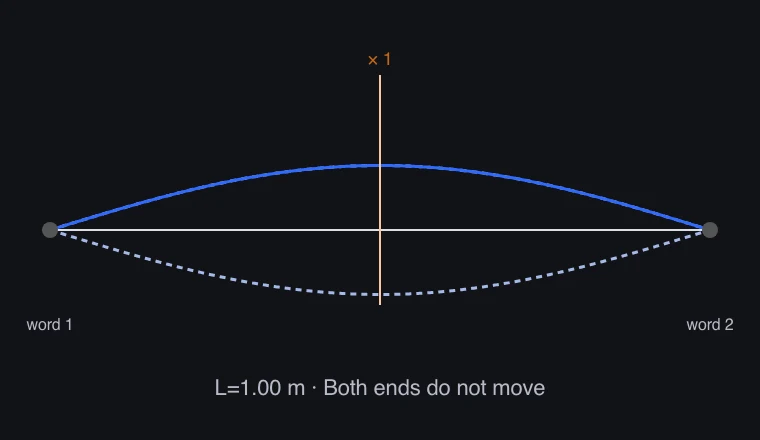
The signals at the ends, when fixed, have a natural frequency of fₙ = nv/(2L). The experiment uses a simplified resonance curve, designed to achieve its maximum value at the natural frequency of the selected mode. By changing the driving frequency up and down, we can read the amplitude and compare the width of the curve by changing the damping.
This is not the result of calculating the overall excessive motion of an entire string or the sum of all modes. Even with a typical damped harmonic oscillator, the maximum frequency of the displacement response will tend to be slightly smaller than the undamped natural frequency due to damping; this allows us to differentiate between experimental results and general resonance.
Key relationships and symbols
fₙ = nv/(2L) (natural frequencies of a string fixed at both ends) · f_drive ≈ f_natural (near resonance with weak damping)
| Symbol | Meaning | Unit |
|---|---|---|
| f_drive | External driving frequency | Hz |
| f_natural | Natural frequency of the system | Hz |
| L | String length | m |
| v | Wave speed on the string | m/s |
Worked example
If the fundamental frequency is 5 Hz, and we oscillate it with a frequency of 4·5·6 Hz, what happens?
In the experimental mode modeling, the amplitude is largest at 5 Hz. When increasing the damping within the same mode, the maximum response decreases, and the changes near resonance become smoother. When comparing, the string length and wave speed are kept constant.
Common misconceptions
- Resonance is not simply about having a high frequency of vibration. It is a relationship between a system’s response and its oscillation.
- In all damped vibration systems, the maximum displacement amplitude does not exactly coincide with the exact frequency of the undamped natural frequency.