
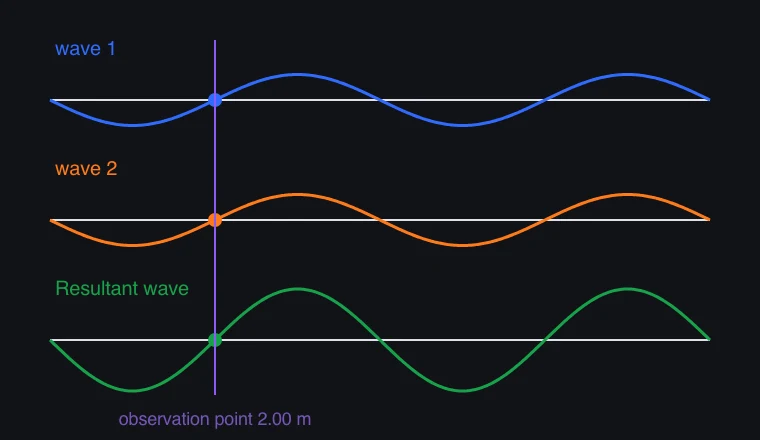
Adding wave displacements
If the displacement is positive and negative relative to a fixed position, the resultant displacement is y = y₁ + y₂. When peaks meet, the wave becomes higher, and when a peak meets a trough, they diminish each other. It is necessary to add displacements of waves at the same time and at the same position, not simply adding their amplitudes.
Linear waves can continue their individual progression even after being overlapped. The fact that two pulses briefly overlap and become flattened does not mean that the wave is permanently gone. When analyzing interference, it is important to compare the individual waves with the combined wave.
Phase difference is a difference in oscillation timing
When two waves with the same frequency have the same phase, the phase difference is 0°, resulting in constructive interference. If the phase difference is 180°, one wave goes up while the other goes down. For complete destructive interference to be possible at a point, the two amplitudes must be equal.
With the same frequency and amplitude A, the resulting amplitude is 2A|cos(Δφ/2). Δφ represents the phase difference between the two waves. If the phase difference is 90°, the resulting amplitude is √2A; even if it is 180°, the two amplitudes will differ, resulting in a remaining oscillation.
Why does the frequency of vibration cause the resulting composite wave to continuously change?
The frequency of one signal changes relative phase compared to the other two as time passes. This is not because we continuously reinforce the fact that they initially had the same phase. When you add the closest two frequencies, you can observe a slow fluctuation in the size of the frequency.
In the experiment, the estimated amplitude, which is assumed to be the maximum and minimum values over a certain period of time, can vary depending on the observed range. When comparing two different frequencies, do not simply view a single frame; instead, thoroughly examine the time graph of the observed points. The two signals in the experiment are independently set simple waveforms.
Key relationships and symbols
y = y₁ + y₂ · A_resultant = 2A|cos(Δφ/2)| (equal amplitudes and frequencies)
| Symbol | Meaning | Unit |
|---|---|---|
| y₁, y₂ | Individual displacements at the same position and time | m |
| A | Amplitude of each wave | m |
| Δφ | phase difference | ° or rad |
Worked example
When combining identical waves with the same frequency and amplitude of 0.3 m, what is the result?
At a phase difference of 0°, the resulting amplitude is 0.6 m, and at 180°, it is 0. If we differentiate the two amplitudes using 0.3 m and 0.2 m, then a phase difference of 180° results in 0.1 m.
Common misconceptions
- The condition of “anti-phase” alone does not guarantee complete cancellation. The amplitudes must also be equal.
- The fact that there exists a point of cancellation does not mean that the total energy of the wave disappears.