
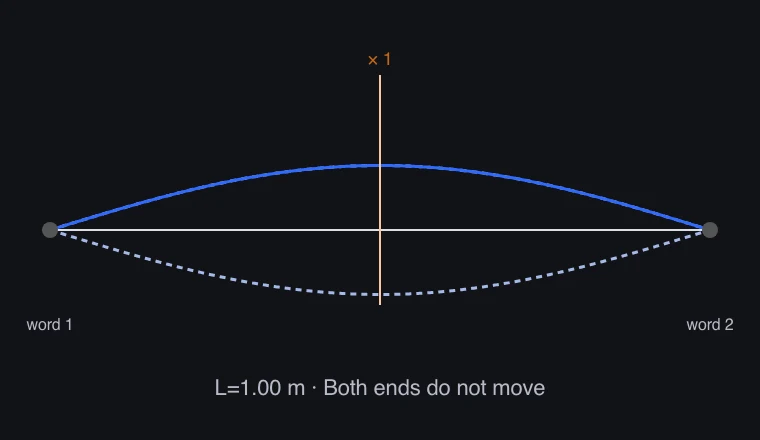
The wave pattern is what appears stationary
A node of a standing wave has displacement 0 at every instant. An antinode has the greatest oscillation amplitude and continues moving up and down. The whole string can pass through equilibrium at one instant, but that does not make every point a node.
Adjacent nodes are separated by λ/2, and a node and its nearest antinode by λ/4. Unlike a traveling wave, whose crests move along the medium, a standing wave has fixed node and antinode positions. Points within one segment between nodes oscillate in phase; neighboring segments oscillate in opposite phase.
What wavelengths would enter only on the fixed lines?
The line with fixed ends must have both ends as nodes. Since the length L contains n half-wavelengths, we have L = nλₙ/2, and λₙ = 2L/n. If the wave speed is v, then the natural frequency is fₙ = nv/(2L).
The fundamental mode n = 1 has one antinode; n = 2 has two. For a string fixed at both ends, mode n has n antinodes and n + 1 nodes, including the ends. Do not apply this expression unchanged to other boundary conditions, such as open or closed pipes.
How are standing waves related to resonance?
Driving a string near one of its natural frequencies can increase that mode’s response. A standing wave describes a spatial vibration pattern; resonance describes an increased response to driving. The two terms do not have exactly the same meaning.
The simulation shows the steady-state response of one selected mode. In a real string, the driving position affects which modes appear strongly, and several modes can overlap. Damping changes both response amplitude and the sharpness of resonance.
Key relationships and symbols
L = nλₙ/2 · λₙ = 2L/n · fₙ = nv/(2L), n = 1, 2, 3, …
| Symbol | Meaning | Unit |
|---|---|---|
| L | String length | m |
| n | Mode number | Positive integer |
| v | Wave propagation speed | m/s |
| fₙ | n-th natural frequency | Hz |
Worked example
What are the first two modes of a fixed end string with a length of 1 m and a wave velocity of 10 m/s?
The fundamental frequency is 5 Hz and the wavelength is 2 m. The second mode has frequency 10 Hz and wavelength 1 m, with two antinodes and three nodes.
Common misconceptions
- An antinode is a position of maximum oscillation amplitude, not a point that is always highest.
- The distance from a node to its nearest antinode is ¼ of a wavelength, not half a wavelength.