
Meaning and mechanism
The aliquot factor D=Vt/Va is the dimensionless ratio of total final volume to aliquot volume.
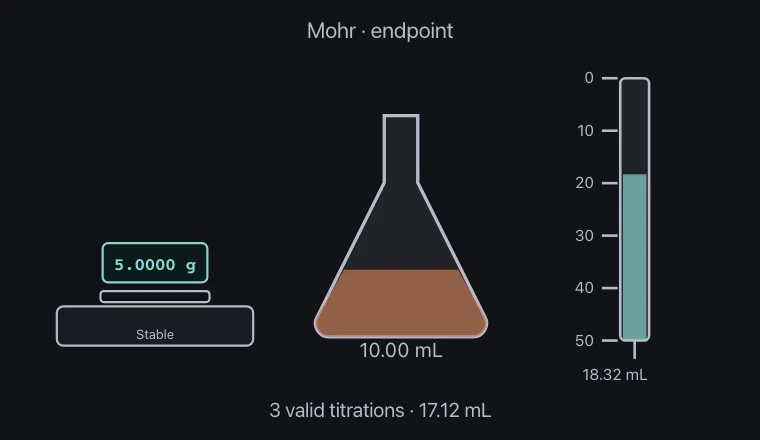
Silver nitrate volume relates to chloride equivalents. With potassium chromate indicator, observe a pale reddish-brown endpoint after mixing.
Relationships and conditions
Convert chloride amount to NaCl mass, divide by sample mass and multiply by 100 to obtain mass %.
Apply only supplied blank measurements. The educational indicator and pH conditions are not a verified representation of the entire current Food Code.
What to observe in the food simulation
Ag⁺ reacts with Cl⁻ in a 1:1 ratio to precipitate AgCl. The endpoint’s reddish brown shows excess silver ions reacting with chromate ions.
This food-edu-v1 educational model does not assess real food safety. Unsuitable pH, color interference, bubbles and overtitration are invalid conditions. Separate silver and chromium waste into designated containers.
Key relationships and symbols
NaCl(%) = (V − V0) × N × f × 58.44 × (Vt/Va) × 100 / (1000 × m)
| Symbol | Meaning | Unit |
|---|---|---|
| D | Total final volume / aliquot volume | 1 |
| V0 | Supplied blank volume used | mL |
| m | Original sample mass | g |
Worked food-analysis example
What is the aliquot factor when 10 mL is titrated from 500 mL of test solution?
500/10=50. Omitting this factor gives 1/50 of the correct NaCl-equivalent content.
Common misconceptions
- NaCl-equivalent content does not mean all chloride was actually present as NaCl.