Titratable acidity
We plan to compare acid amounts expressed as a reference acid.

Practice weighing, titration, drying, and microbial result interpretation with virtual food samples.
Virtual conditions for education
An independent educational simulation. Not affiliated with or endorsed by HRD Korea, Q-net or MFDS. Virtual results do not establish food safety or guarantee exam success.
Explore all Food Lab concepts →6 experiments
Times include reading the explanation and completing all six steps. Your pace may vary.
 Solutions & titration
Weigh and dilute to volume, then use standard acid to determine NaOH concentration and its factor.
 Solutions & titration
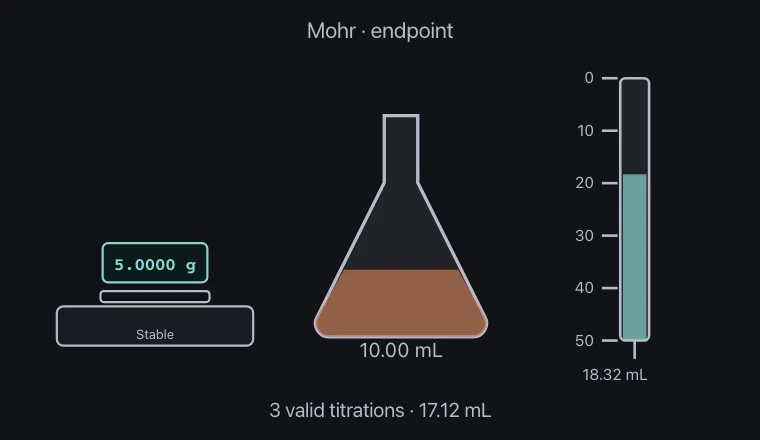
Use the precipitation endpoint and aliquot factor to determine NaCl-equivalent content.
 Gravimetric analysis
Calculate loss on drying from masses before and after drying and constant-mass records.
 Gravimetric analysis
Distinguish residue after ashing from sample loss.
 Microbiological analysis
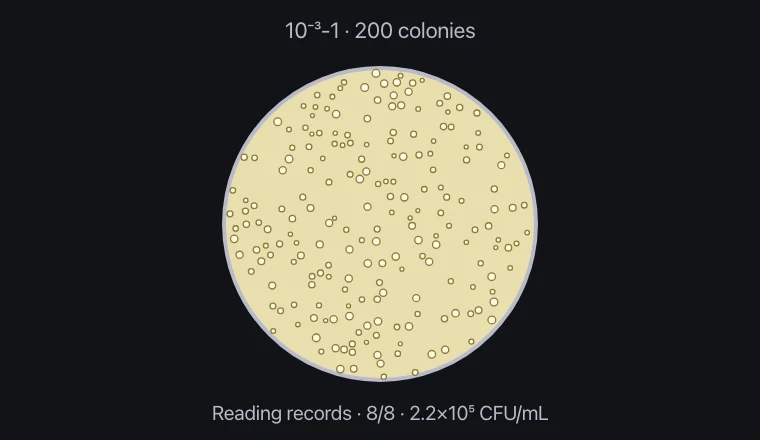
Count colonies on serially diluted replicate plates and calculate CFU.
 Microbiological analysis
Link presumptive, confirmed and completed-test evidence to read qualitative results.
10 in preparation
We plan to compare acid amounts expressed as a reference acid.
We plan to explore free fatty acids in fats and oils and blank correction.
After reviewing the analytical method, we plan to explore redox reactions and recovery.
We plan to connect extraction, solvent recovery, and residue weighing.
We plan to explore nitrogen determination and food-specific protein conversion factors.
We plan to explore an oxidation indicator and the effects of light protection and blanks.
We plan to compare hydrogen ion activity and titrant consumption.
We plan to explore the relation between unsaturation and back titration.
We plan to explore back titration of the alkali remaining after reflux.
We plan to explore the residue separated and extracted after saponification.