
Meaning and mechanism
Dilution fraction d is the original-sample proportion in the final mixture, obtained by multiplying actual transfer volume ratios.
A colony may arise from one cell or a cell cluster; CFU does not equal total cell count.
Relationships and conditions
Use ΣC/(n×v×d) for one step and ΣC/[v×(n1+0.1n2)×d] for two consecutive steps.
Applies to decimal serial dilutions and eligible plates. The reference is an entry point, not verification of all current official conditions.
What to observe in the food simulation
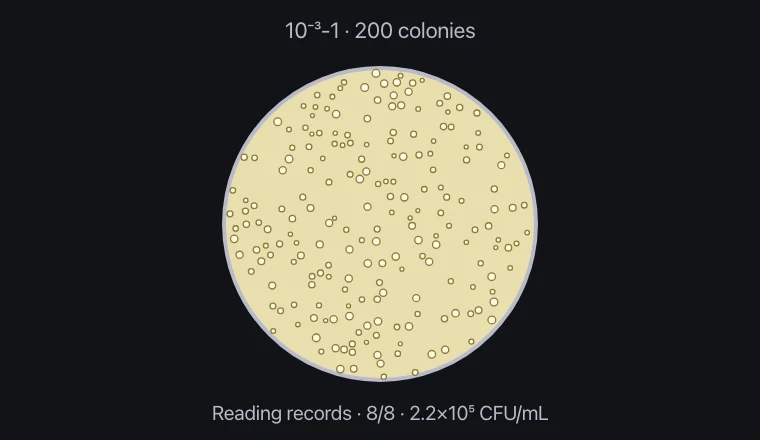
Use dilution fraction d and volume v in the denominator, not dilution factor. Weight two consecutive steps by replicate counts.
The food-edu-v1 range 30–300 is educational. Zero colonies do not guarantee sterility. Distinguish contamination, spreading colonies, low counts and excessive counts. Do not culture unknown microbes at home or open plates.
Key relationships and symbols
CFU/mL = ΣC / [v × (n1 + 0.1n2) × d]
| Symbol | Meaning | Unit |
|---|---|---|
| d | Actual dilution fraction | 1 |
| v | Inoculum volume per plate | mL |
| ΣC | Sum of selected plate colony counts | CFU |
Worked food-analysis example
Is d=1000 for a 10⁻³ dilution?
d=0.001. Dilution fraction and dilution factor are reciprocals.
Common misconceptions
- Zero colonies describe the observed volume and conditions; they do not guarantee sterility or food safety.